NEW: AutoMynd Unveils Patient-Centered AI EMR, Automating Episodes From Referral to Reimbursement Read more →
.svg)
.svg)
.png)
For years, home healthcare organizations have invested heavily in EHR and EMR systems to digitize documentation, streamline OASIS submissions, and support Medicare billing. That digital shift was necessary.
But today, simply having a home healthcare EHR system is no longer a competitive advantage.
As reimbursement models grow more complex, margins tighten, and compliance with scrutiny increases; agencies must move beyond documentation. The next evolution is building an intelligent clinical software ecosystem — one that integrates AI in healthcare, medical coding automation, revenue cycle management (RCM), and real-time workflow orchestration into a unified system of action.
Traditional EHR systems in home healthcare are designed primarily as systems of record. They:
· Store clinical documentation
· Capture OASIS assessments
· Generate care plans
· Support medical billing workflows
· Maintain compliance documentation
While these capabilities are foundational, they are inherently reactive.
Most EHR platforms do not:
· Predict hospitalization risk
· Detect coding inconsistencies in real time
· Flag documentation gaps before claim submission
· Prioritize high-risk episodes operationally
· Integrate seamlessly with automated billing software and AI medical coding engines
In a landscape driven by value-based care, PDGM reimbursement, EVV compliance, and payer scrutiny, static documentation is insufficient.
Home healthcare requires intelligence layered on top of infrastructure.
An intelligent clinical software ecosystem does more than store data. It continuously interprets it.
A true System of Action:
1. Analyzes clinical, coding, and billing data in real time
2. Identifies operational and financial risk
3. Activates automated workflows across teams
For example:
· Incomplete OASIS fields trigger documentation correction before coding
· High-risk comorbidity patterns alert clinicians
· Authorization expiration flags generate automated tasks
· Claims with high denial probability are routed for review
· EVV discrepancies surface prior to billing submission
This convergence of AI-powered EMR software, healthcare workflow automation, and automated medical billing systems transforms documentation into decision-making.
Artificial intelligence is transforming healthcare operations across hospitals and large health systems. Home health care must follow suit.
An AI-enabled clinical software ecosystem can support:
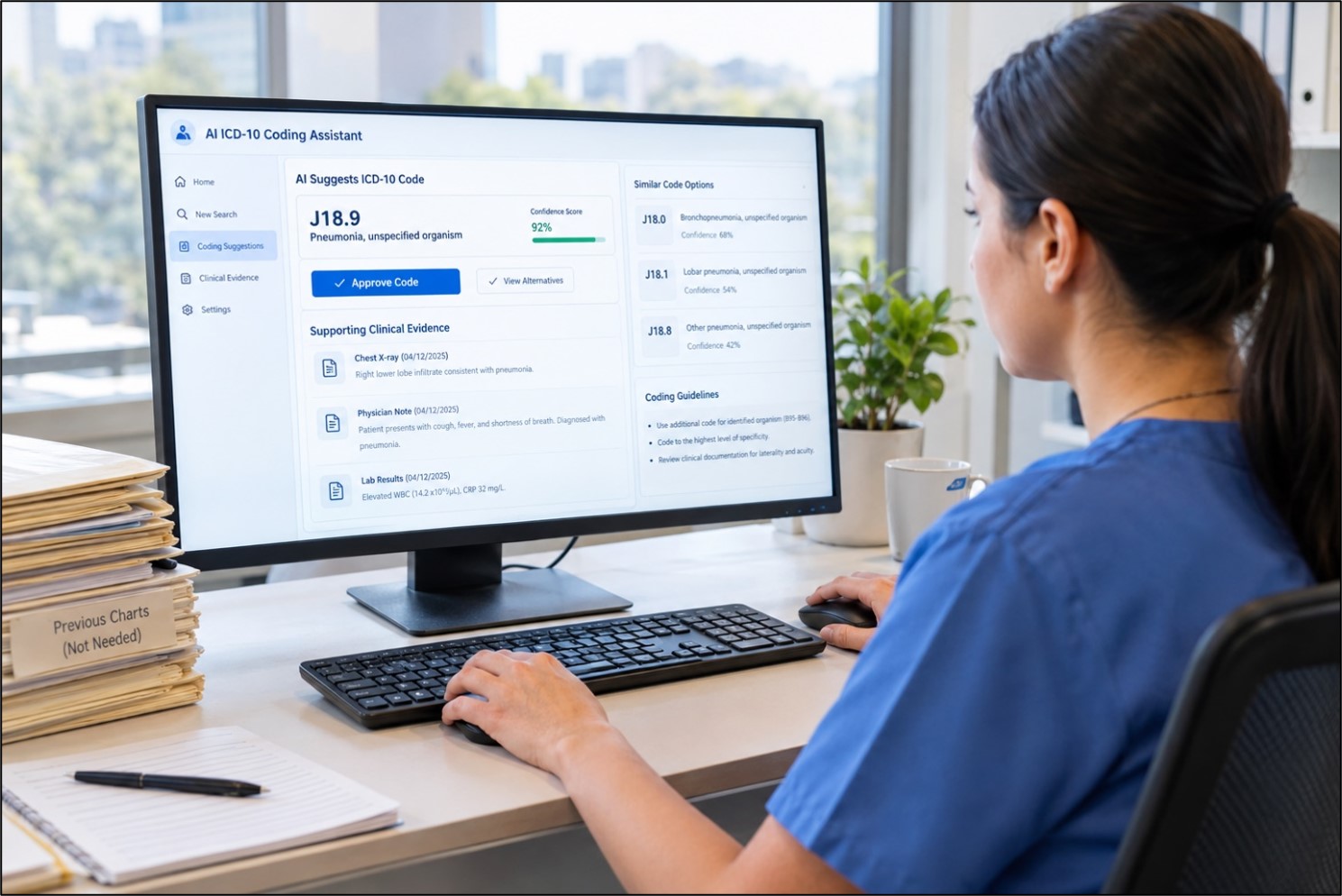
Automated coding engines can:
· Cross-check clinical notes against ICD-10 codes
· Identify missing diagnoses
· Detect unsupported documentation
· Validate PDGM case-mix group accuracy
This reduces rework and strengthens reimbursement integrity.
AI billing automation systems can:
· Analyze historical denial patterns
· Predict high-risk claims
· Scrub documentation before submission
· Identify payer-specific rule changes
This shifts the revenue cycle from reactive denial management to proactive risk mitigation.
Using predictive analytics in healthcare, agencies can:
· Identify patients at risk of hospitalization
· Detect deteriorating functional status
· Forecast low-utilization episodes
· Optimize visit frequency
This improves outcomes while supporting value-based reimbursement strategies.
Perhaps the most transformative evolution is the introduction of intelligent orchestration layers that sit across EHR, EVV, and billing systems.
Rather than replacing existing software, these AI-powered agents continuously monitor data across clinical documentation, medical coding inputs, and claims workflows. When risk signals emerge, they activate tasks, escalate issues, and route exceptions automatically.
For example:
· A documentation discrepancy triggers a coding review
· A recurring payer denial pattern escalates to revenue cycle leadership
· A compliance risk flag generates an audit task
· A high-risk patient profile prompts care team prioritization
This approach transforms home healthcare software from passive infrastructure into coordinated operational intelligence.
Electronic Visit Verification (EVV) adds another layer of complexity.
Common EVV-related revenue challenges include:
· Missed clock-ins
· Location mismatches
· Time discrepancies
· Unauthorized visit durations
An intelligent clinical software ecosystem integrates EVV data directly into:
· Medical billing validation
· Authorization checks
· Compliance monitoring
· Revenue cycle automation
When EVV, clinical documentation, and AI billing software operate cohesively, preventable denials decline significantly.
CMS scrutiny and OIG audits demand structured documentation and defensible coding practices.
An AI-enabled clinical software ecosystem embeds compliance logic directly into workflows:
· Automated OASIS validation checks
· Structured diagnosis alignment
· Audit-ready documentation trails
· Coding defensibility alerts
· Real-time policy enforcement
Rather than relying on manual compliance oversight, agencies build compliance into the architecture of their systems.
The home healthcare industry faces:
· Workforce shortages
· Margin compression
· Value-based reimbursement expansion
· Increasing regulatory oversight
· Rising payer complexity
Organizations that rely solely on traditional EHR platforms will struggle to maintain efficiency and profitability.
Those that adopt intelligent clinical software ecosystems — integrating AI medical coding, automated claims processing, healthcare workflow automation, and predictive analytics — gain measurable advantages:
· Lower denial rates
· Faster reimbursement cycles
· Reduced administrative burden
· Improved clinical outcomes
· Stronger audit defensibility
· Scalable operational models
The next generation of home healthcare technology will not be defined by documentation templates or mobile apps alone.
It will be defined by intelligence.
Forward-looking agencies are beginning to layer orchestration capabilities across their EHR, billing, and compliance systems — enabling real-time monitoring, automated workflow activation, and predictive financial oversight.
In this model, EHR remains foundational.
But intelligence becomes a differentiator.
When clinical documentation, AI medical coding, billing automation, and workflow orchestration operate as a unified system of action, home healthcare organizations transform reactive administrators into proactive, data-driven enterprises.
Moving beyond EHR is no longer optional.
It is the foundation of sustainable growth in modern home healthcare.
.svg)