NEW: AutoMynd Unveils Patient-Centered AI EMR, Automating Episodes From Referral to Reimbursement Read more →
.svg)
.svg)

Choosing a home health or home care software platform is no longer a “systems upgrade.” It’s a strategic decision that touches survey risk, revenue integrity, staffing capacity, and your ability to compete in a value-based world.
Most demos still emphasize polished dashboards and flashy AI. Very few show how their software solutions will keep you aligned with CMS rules, adapt to OASIS changes, protect your data, and actually reduce friction in documentation, intake, and billing solutions across home health and home care lines of business.
This guide is written for executive buyers who want to cut through the noise and evaluate home health and home care software solutions on what really matters.
If the platform cannot keep pace with CMS, OASIS, and state rules, the rest of the feature set is irrelevant.
Medicare home health Conditions of Participation (CoPs) in 42 CFR Part 484 define the minimum health and safety standards agencies must meet to participate in the program. These requirements drive how assessments, care planning, coordination, and clinical records must be documented.
Your home health software solutions should clearly support:
· Comprehensive assessments that meet OASIS requirements and flow directly into the clinical record.
· Individualized, measurable care plans aligned with CoP expectations for care planning and coordination.
· Survey-ready documentation that can be followed by state surveyors, MACs, and managed care reviewers without manual reconstruction.
When a vendor claims “we’re compliant,” push for specifics. Ask them to open a chart and show how their home health software supports care planning requirements under §484.60 and clinical records requirements under the CoPs, not just internal QA.
OASIS has become a moving target. OASIS‑E1 took effect January 1, 2025, and CMS is implementing OASIS‑E2 on April 1, 2026, with changes to selected items and time points.
For a home health or home care buyer, that means one critical question:
“How do your software solutions stay current as OASIS and state requirements change, and how quickly do we see those changes in production?”
Look for:
· A documented regulatory monitoring process with named staff responsible for tracking CMS rulemaking, OASIS guidance, and state program updates.
· Release notes tied to specific regulatory references (e.g., CMS transmittals, manual updates, state Medicaid bulletins), not vague “regulatory updates included.”
· Flexible configuration for state-specific requirements: forms, visit frequencies, supervisory intervals, EVV rules, and waiver program documentation.
If a vendor cannot show recent, concrete work related to OASIS‑E1 and a roadmap for OASIS‑E2, you’re likely buying into lagging compliance.
Home health and home care are delivered in unpredictable environments: cramped apartments, rural homes with poor connectivity, complex family dynamics, and thin staffing. If the people designing your software have never managed that reality, they’ll get the details wrong.
During evaluation, ask directly:
· How many executives or product leaders have worked as RNs, therapists, social workers, or home care aides?
· Who has actually managed a home health census, prepared for survey, or owned HHVBP performance?
· How often do your clinical leaders ride along with field clinicians using your software solutions?
You want a product philosophy rooted in clinical and operational reality:
· A nurse in home health documenting OASIS and visit notes within a tight visit window.
· A home care supervisor needing fast, accurate visibility into tasks completed, missed visits, and caregiver compliance.
· QA, coding, and billing teams relying on the same documentation to support revenue, quality scores, and audit readiness.
When leadership carries that experience, it shows up in how the home health and home care workflows are built: fewer clicks to critical fields, sensible defaults based on diagnoses and payers, and documentation flows that follow how clinicians think instead of forcing them into awkward software patterns.
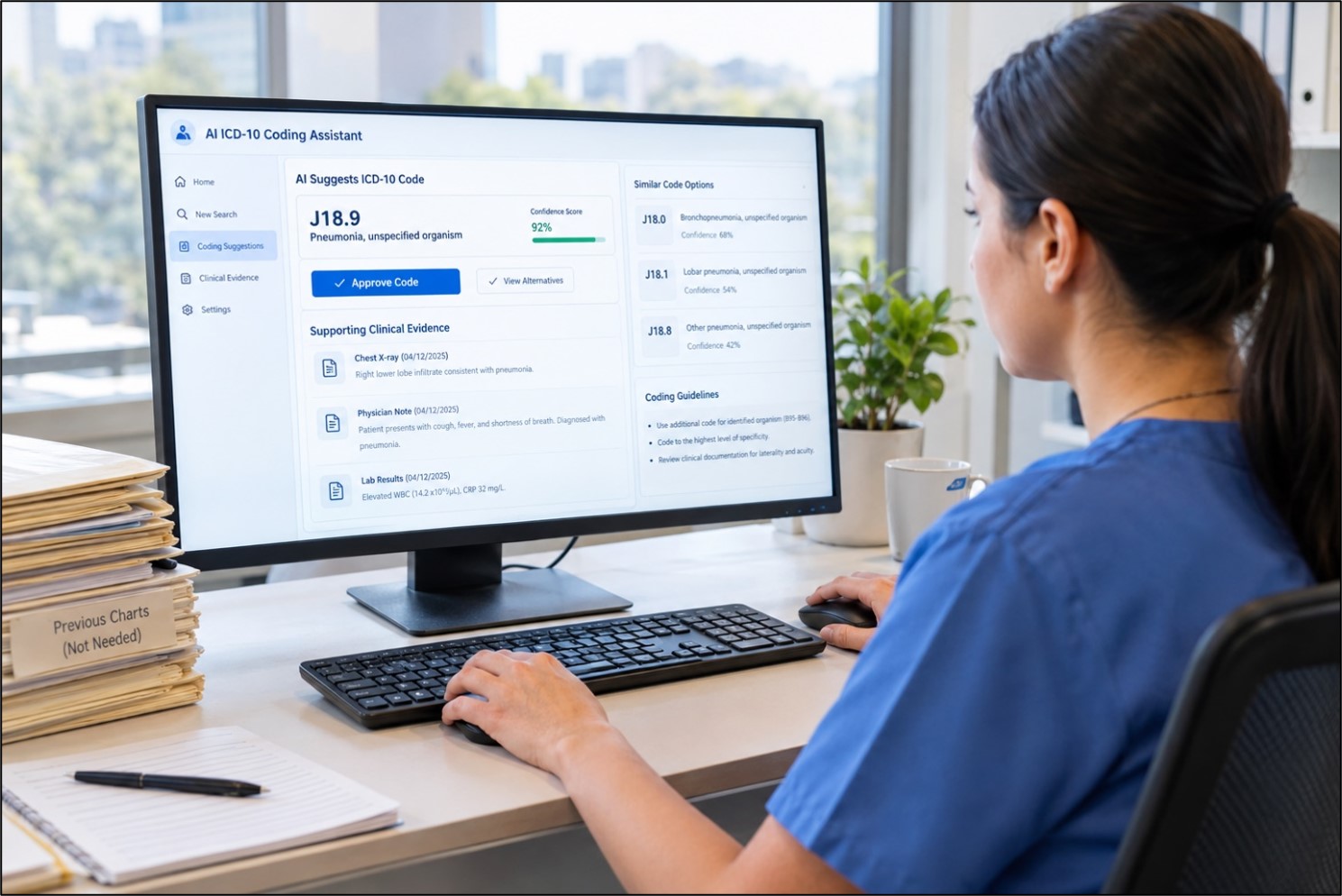
The market is crowded with home health and home care software solutions claiming AI-powered documentation, smart assistants, and other shiny features. Many of these don’t move core metrics—visit time, QA cycle time, denial rates, or staff turnover.
The filter is simple:
“Does this feature materially reduce time and cognitive load in documentation, intake, billing, or prior authorization while preserving or improving quality?”
For most agencies, the worst friction isn’t in the dashboard—it’s in the daily work:
· Clinical documentation: OASIS, visit notes, orders, care plans, discipline-specific assessments, coordination notes.
· Intake and eligibility: referral capture, payer and benefit validation, capacity-aware scheduling.
· Prior authorization and utilization management: initial and ongoing auth, resubmissions, denials.
· QA, coding, and billing solutions: reviewing OASIS, resolving discrepancies, ensuring documentation supports codes and payment, managing ADRs and audits.
High-value home health and home care software solutions will:
· Reduce duplicate data entry between OASIS, visit notes, and orders.
· Flag missing or inconsistent data before charts hit QA.
· Capture the right data at intake to support billing and prior auth from the start.
· Give billing solutions and revenue cycle teams cleaner, more structured documentation to work from.
These are the capabilities that protect margin and reduce burnout—not cosmetic UI changes.
A growing trend in home health and home care software solutions is the use of systems that guide clinicians through visit notes by verbally prompting them question by question, then recording spoken answers into the chart. This is often marketed as AI-driven documentation, but for clinicians and back office teams it’s rarely efficient.
These voice‑prompted tools typically:
· Lock clinicians into a rigid, linear script that doesn’t match how assessments actually unfold in the home.
· Require constant back‑and‑forth with the system (“Now describe pain,” “Now document mobility,” “Now summarize education”), interrupting patient interaction and clinical thinking.
· Produce fragmented, repetitive narrative that QA, coding, and billing solutions must later clean up, adding work instead of removing it.
By contrast, transcription‑based visit note population—where the clinician narrates the visit in a natural clinical order and the system maps that content into structured fields—tends to be far more effective:
· Clinicians keep their clinical reasoning and narrative flow intact; the software handles placement into the right sections of the home health or home care note.
· The documentation better reflects how care was actually delivered, which supports QA review, coding, and billing solutions.
· Downstream teams see fewer disjointed snippets and more coherent documentation, which reduces rework and denial risk.
The net effect: voice‑prompted Q&A visit note tools rarely produce sustained time savings and often increase visit length, cognitive load, and downstream editing. If a home health or home care vendor leans heavily on this model as a flagship feature, ask for hard metrics—minutes saved per visit, QA turnaround time, denial rates—before accepting it as real value rather than noise.
The features that truly matter often look less dramatic: smart templates keyed to diagnoses and payers, subtle automation in care plan construction, and guardrails that prevent incomplete documentation from reaching billing. That’s where your software solutions must deliver.
Your home health and home care software vendor is a business associate under HIPAA. They handle large volumes of electronic protected health information (ePHI), and any weakness in their controls becomes your problem with regulators, payers, and patients.
Two frameworks matter most for executive buyers:
The HIPAA Security Rule establishes national standards to protect ePHI created, received, used, or maintained by covered entities and their business associates. It requires appropriate administrative, physical, and technical safeguards to ensure confidentiality, integrity, and availability of ePHI.
In your evaluation, expect the vendor to articulate:
· A signed Business Associate Agreement (BAA) with clear allocation of responsibilities.
· Role-based access controls with least‑privilege defaults.
· Encryption of data in transit and at rest.
· Detailed audit logging of access to PHI.
· A documented incident response plan and breach notification process aligned with HIPAA rules.
If they cannot explain their HIPAA Security Rule posture in clear, non‑technical language, that is a risk signal.
SOC 2 is widely used to assess whether a technology provider has adequate controls around security, availability, processing integrity, confidentiality, and privacy. For healthcare and healthtech, SOC 2 is increasingly expected alongside HIPAA as part of vendor due diligence.
For your home health and home care software solutions, ask for:
· A recent SOC 2 Type II report (not just Type I) that covers the infrastructure and applications where your data will live.
· A summary of any significant exceptions and how they were addressed.
· A mapping of SOC 2 controls to your internal security and compliance framework.
When HIPAA-aligned safeguards and SOC 2 controls are both in place, your confidence in the vendor’s ability to support secure billing solutions, interoperability, and analytics should be substantially higher.
CMS rules are only part of the environment. State Medicaid programs, waiver programs, EVV mandates, and managed care contracts all impose additional documentation and workflow requirements that will directly impact your teams.
Evaluate whether the home health and home care software solutions can:
· Configure state-specific documentation, assessments, and supervisory visit requirements.
· Support EVV requirements and integrate with state aggregators where mandated.
· Handle payer-specific documentation needs for key managed care plans and Medicaid programs.
· Capture the data elements required for state quality programs and value-based initiatives, not just federal programs.
Have vendors walk through a real scenario from your operation, such as:
· A Medicaid waiver home care case with prior authorization requirements and EVV.
· A home health admission under a managed care contract with specific utilization rules.
The fewer manual workarounds your intake, clinical, and billing teams need to invent, the better the software fit.
To keep the selection process focused, anchor your RFP or internal scorecard around a few domains that matter most for home health and home care operations.
· Clear alignment with current home health CoPs and OASIS versions, including OASIS‑E1 and transition to OASIS‑E2 effective April 1, 2026.
· Documented process and track record for timely CMS and state regulatory updates.
· Clinical leadership embedded in product design, implementation, and ongoing optimization.
· Proven reduction in documentation time per visit (for both home health and home care) backed by customer data, not anecdotes.
· Strong support for intake, eligibility verification, and prior authorization workflows.
· Configurable workflows and templates for your dominant payer and program types.
· Limited reliance on “showy” features such as rigid voice‑prompted documentation as the main value story; greater emphasis on practical automation that improves clinical documentation and billing solutions.
· Current BAA aligned with your legal and compliance expectations.
· HIPAA Security Rule controls described clearly, with evidence of risk analysis and safeguards.
· Recent SOC 2 Type II report covering relevant systems, with any exceptions understood and acceptable.
· A realistic implementation plan that accounts for data migration, training, and regulatory changes over the next 12–24 months.
· References from agencies with similar size, payer mix, and service lines across both home health and home care.
· Evidence that the vendor will act as a partner on workflow redesign, not only as a technical “ticket taker.”
The best home health and home care software solutions rarely win because they had the flashiest demo. They win because:
· Clinicians can document faster and more accurately.
· Intake, QA, coding, and billing solutions have cleaner data to work from.
· Your organization stays aligned with evolving CMS, OASIS, and state requirements.
· ePHI is protected with the same rigor you expect from your own teams.
As an executive buyer, your job is to keep the focus on these fundamentals:
· Regulatory alignment and OASIS readiness.
· Clinical and operational realism in workflow design.
· Measurable efficiency gains in documentation, intake, and revenue cycle.
· Robust, verifiable data protection through HIPAA and SOC 2.
If a feature doesn’t move one of those levers, it’s likely fluff. The right platform will let your teams spend less time fighting software and more time delivering care, managing growth, and protecting your margin in both home health and home care.
.svg)


.png)