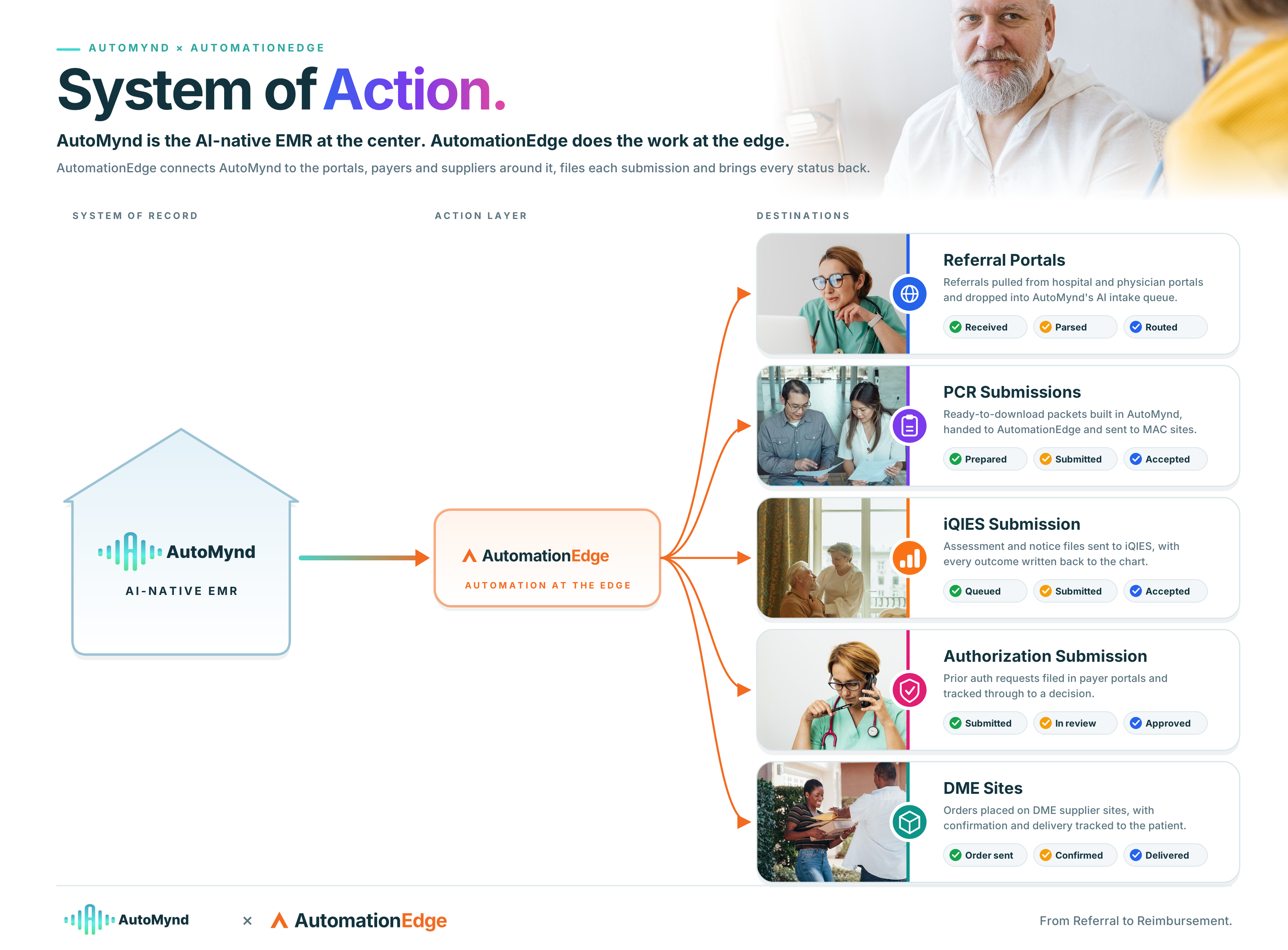
NEW: AutoMynd Unveils Patient-Centered AI EMR, Automating Episodes From Referral to Reimbursement Read more →


Most home health agencies find out a chart can't be defended on the day the Additional Documentation Request (ADR) arrives. By then the episode is billed, the clinician has moved on, and the fix is a scramble.
The stakes are measurable. CMS reported a 6.9% improper payment rate for home health in its 2025 Medicare fee-for-service data, about $1.1 billion in projected improper payments. Nearly half of those dollars, 49.4%, came from insufficient documentation.
That is the uncomfortable part. Much of the money at risk isn't about care that shouldn't have happened. It's about care that happened and wasn't documented in a way a reviewer could follow.
The clock also matters. Medicare contractors expect a response to an ADR within 45 days, and a missed response is consistently the top medical review denial, a nonresponse coded M127 (Palmetto GBA). Agencies that are ADR ready don't race that clock. Their packet is already assembled.
Reviewers ask one question: does the record, on its own, prove the patient qualified and the care was necessary? In practice that comes down to five areas.
The latest contractor data shows where agencies lose. In CGS's April to June 2026 Targeted Probe and Educate (TPE) results, the top home health denial reasons were:
Source: CGS Home Health TPE Results. These figures cover one Medicare contractor, but the pattern is familiar to anyone who has worked an ADR.
The gaps that sink an ADR are rarely dramatic. They look like this:
Most agencies catch these with retrospective audits: a QA nurse samples charts after the fact, or the team assembles evidence only after the letter lands. Both have the same flaw. They find problems when the clinician who could fix them has moved on, and when the claim has already gone out.
Sampling adds another blind spot. If QA reviews 10% of charts, the other 90% go to billing unchecked, and those are the charts a reviewer can still pull.
The fix is to move the review to the moment the documentation is created. Every chart gets checked as each visit is completed, not sampled weeks later.
That's how ADR Readiness works inside the AutoMynd EMR:
The result is a different question for leaders. Instead of asking "can we defend this chart?" after the letter, you see which charts aren't defensible yet, while there's still time to fix them.
An Additional Documentation Request is a letter from a Medicare contractor asking for medical records to support a claim. If the records don't show the patient qualified and the services were necessary, the claim is denied.
Medicare contractors generally expect a response within 45 days of the letter. A missed response leads to a nonresponse denial, coded M127.
In recent CGS TPE results, the top reasons were skilled nursing not medically necessary, an invalid initial certification, therapy visits not medically necessary, and a missing or incomplete face-to-face encounter.
Review every chart as visits are completed, fix gaps while the clinician can still act, and keep the ADR packet assembled throughout the episode.
No. AutoMynd surfaces gaps with evidence and a suggested fix, and your clinicians and QA team make every correction.
ADR Readiness is built into the AutoMynd EMR, the AI EMR for home health, from referral to reimbursement. Request a demo to see how your team can review every chart before the claim goes out.
One AI-native EMR for intake, documentation, QA, coding and billing, built for home health agencies.
Book a demo