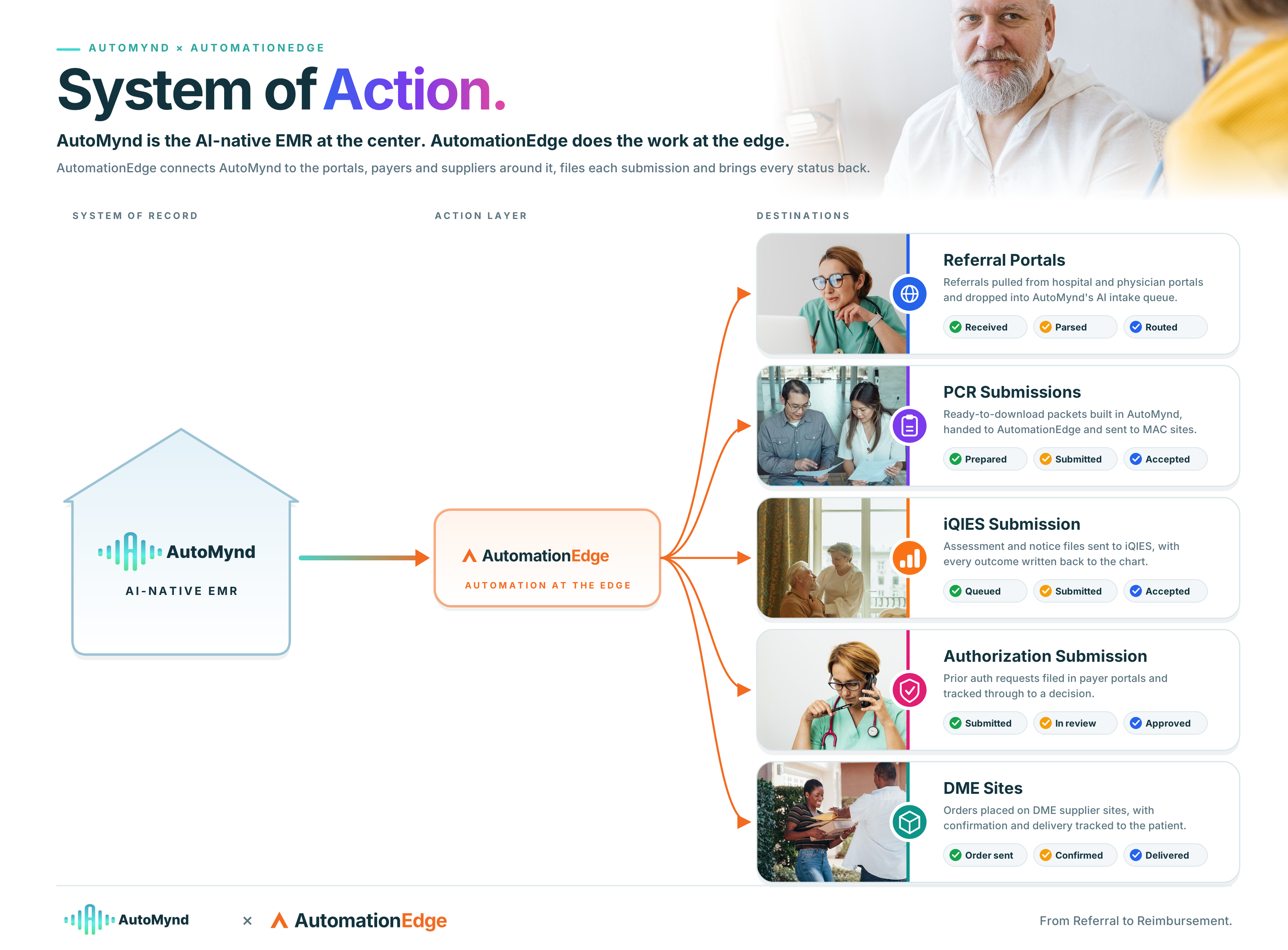
NEW: AutoMynd Unveils Patient-Centered AI EMR, Automating Episodes From Referral to Reimbursement Read more →


Every home health clinical manager knows this moment. Case conference starts in five minutes, and you need to know where one patient stands.
The answer is in the chart, but the chart is spread across a dozen or more tabs: visit notes, vitals, the medication log, orders, the care plan, assessments, coordination notes. In AutoMynd's own Patient360 view, that's 16 tabs for a single patient.
So clinical and case managers do what they've always done. They click, skim, and piece the story together from memory. Multiply that by a full caseload and it's hours a week spent finding information instead of acting on it.
A patient-level AI assistant changes the question from "where is that documented?" to "what does the chart say?"
The questions aren't complicated. Finding the answers is. These come up in nearly every case conference, recert review and physician call:
The last question carries regulatory weight. Under the home health Conditions of Participation, agencies must promptly alert the physician when a patient's condition suggests outcomes aren't being met or the plan should change. The plan of care must also be reviewed at least every 60 days (42 CFR 484.60). Both depend on a clinical manager seeing the change quickly.
The Patient360 Assistant sits inside the patient's record in the AutoMynd EMR. You type a clinical question in plain language and get an answer drawn from that patient's chart, with the source attached.
Here's a worked example with an illustrative patient, an 81-year-old woman with heart failure:
"What changed since her last nursing visit?"
Sources: SN visit note (Oct 17), vitals, medication log.
"Is she still homebound with a skilled need?"
Two things matter in those answers. Every point traces to a document you can open, so you can verify before you act. And the assistant flags the gap without fixing it on its own. Your clinicians decide what happens next, whether that's a call to the physician, an added visit or a teaching update.
The benefit isn't only time saved. Clinical managers spend more of their day on judgment calls, patients get attention when a change first shows up, and documentation stays strong enough to hold up under CMS review.
If you're evaluating AI for your clinical team, hold it to these standards:
A clinical manager oversees patient care across a caseload: reviewing documentation, running case conferences, approving plans of care and recerts, and coordinating with physicians.
A patient-level AI assistant answers clinical questions from the chart in seconds, such as what changed since the last visit or whether a patient still meets homebound and skilled need criteria, with sources attached.
It should be verifiable. Look for an assistant that cites the documents behind each answer, so a clinician can confirm before acting.
No. It finds and summarizes information. Decisions about care, orders and documentation stay with your clinicians.
At least every 60 days, and sooner when the patient's condition changes, under 42 CFR 484.60.
The Patient360 Assistant is built into AutoMynd, the AI EMR for home health, from referral to reimbursement. Request a demo to see how your clinical managers can walk into case conference with the whole picture.
One AI-native EMR for intake, documentation, QA, coding and billing, built for home health agencies.
Book a demo