NEW: AutoMynd Unveils Patient-Centered AI EMR, Automating Episodes From Referral to Reimbursement Read more →
.svg)
.svg)
.png)
Artificial intelligence is rapidly entering the home health market — particularly in the form of AI clinical documentation tools, voice-to-text charting, and automated note summarization — signalling a shift in how home health EMR and EHR platforms must evolve.
But AI notetaking alone does not transform an organization.
Home health agencies today face mounting pressure from:
· PDGM reimbursement complexity
· OASIS accuracy scrutiny
· Increasing claim denials
· EVV enforcement
· Staffing shortages
· CMS audit intensity
· Margin compression
In this environment, AI clinical documentation software must evolve beyond productivity enhancement. It must become the foundation of an Intelligent System of Action — where documentation, medical coding, billing automation, compliance, and workflow orchestration operate as one cohesive ecosystem. Learn how AI-assisted clinician charting tools like QAgent power this transformation.
Many AI healthcare tools focus narrowly on:
· Voice-to-text documentation
· Automated visit summaries
· Structured note formatting
These features improve efficiency, but they do not solve larger enterprise challenges:
· Documentation-to-coding mismatches
· Unsupported ICD-10diagnoses
· PDGM case-mix inaccuracies
· Claim denials due to missing documentation
· Authorization misalignment
· Compliance gaps
If clinical documentation sits passively in the EMR — even if AI-generated — it remains a system of record.
The opportunity is far greater.
An Intelligent System of Action does three things:
1. Interprets clinical documentation in real time
2. Identifies financial and compliance risk
3. Activates automated workflows across teams
This transformation connects:
· AI clinical documentation software
· AI medical coding engines
· Revenue cycle management (RCM) systems
· Automated claims processing platforms
· Compliance monitoring tools
· EVV data streams
Instead of waiting for post-submission denial reports, agencies operate with continuous oversight.
Documentation becomes intelligent.
Modern AI-powered EMR systems can do more than transcribe.
Advanced platforms can:
· Extract structured data from clinical narratives
· Validate OASIS responses against documentation
· Identify missing comorbidities
· Detect documentation inconsistencies
· Highlight unsupported diagnoses
This structured data feeds directly into:
· AI medical coding validation
· PDGM grouping accuracy checks
· Automated claims readiness assessments
· Denial probability scoring
The results: reduced rework, fewer denials, and improved reimbursement accuracy.
Home health reimbursement depends on documentation of integrity.
When documentation and coding are disconnected, agencies experience:
· Increased claim denials
· Revenue leakage
· Audit exposure
· Delayed reimbursement cycles
· Increased days in accounts receivable (AR)
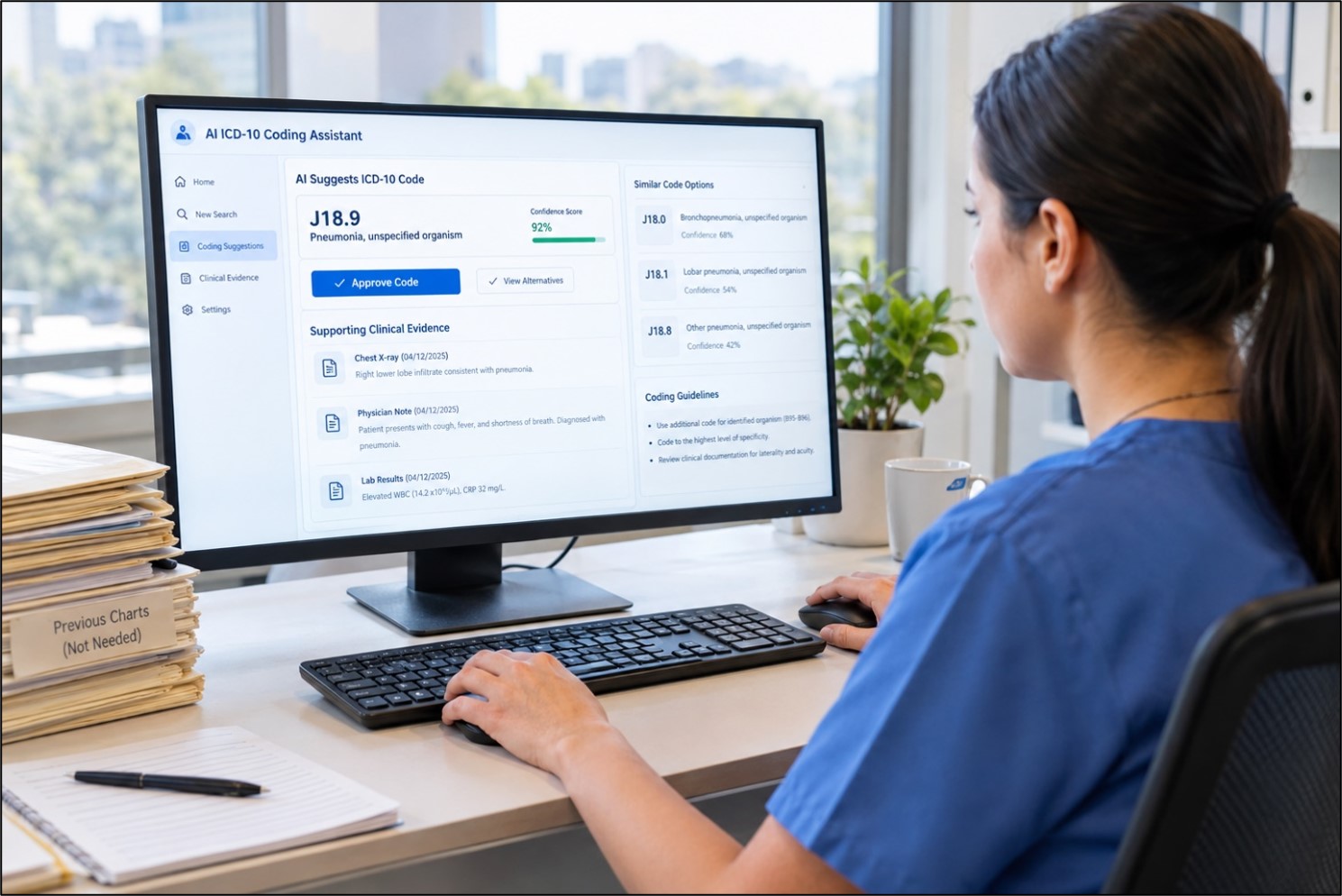
AI medical coding software can:
· Cross-reference clinical documentation with ICD-10 codes
· Identify missing diagnosis specificity
· Flag unsupported primary diagnoses
· Validate comorbidity documentation for PDGM
Meanwhile, automated claims processing systems can:
· Detect incomplete documentation before submission
· Identify payer-specific rule discrepancies
· Predict denial risk using historical data
· Route high-risk claims for review
When documentation, coding, and billing automation operate cohesively, agencies move from reactive correction to proactive prevention.
A true System of Action transforms documentation into operational triggers.
For example:
· A missing physician signature generates an automated compliance task
· A high-risk PDGM grouping triggers coding review
· A documentation inconsistency routes to a clinical supervisor
· A recurring payer denial pattern escalates to revenue cycle leadership
· EVV discrepancies surface before billing submission
Rather than relying on manual oversight, AI-powered agents continuously monitor documentation, coding, and billing workflows — activating corrective action in real time.
These orchestration layers sit across existing EMR, EVV, and billing systems, turning disconnected processes into coordinated intelligence.
The EHR remains foundational.
The intelligence layer makes it actionable.
Under PDGM, small documentation errors can significantly impact reimbursement.
An AI-enabled documentation ecosystem can:
· Identify case-mix misalignment
· Detect low-utilization payment adjustment (LUPA) risk
· Forecast reimbursement variance
· Highlight under-documented comorbidities
· Flag visit utilization anomalies
This elevates documentation from compliance requirement to revenue intelligence engine.
CFOs and revenue cycle directors gain visibility into:
· Revenue-at-risk by episode
· Denial trend analytics
· Coding accuracy rates
· Documentation quality metrics
· Payer performance insights
AI clinical documentation becomes a financial strategy tool — not just a clinical productivity solution.
CMS scrutiny and OIG audits demand defensible documentation.
AI healthcare platforms can embed compliance logic directly into documentation workflows:
· Automated OASIS validation
· Structured diagnosis enforcement
· Policy-driven documentation prompts
· Real-time compliance alerts
· Audit-ready documentation trails
Instead of retrospective chart audits, agencies adopt continuous compliance monitoring.
This reduces risk exposure and strengthens survey readiness.
Clinician burnout remains a major concern in home health.
AI documentation tools reduce typing burden — but intelligent orchestration reduces cognitive burden.
When systems automatically:
· Flag high-priority patients
· Route documentation corrections
· Prioritize claims for review
· Surface compliance risks
Clinicians and billing teams focus on critical tasks — not administrative guesswork.
AI-powered healthcare workflow automation improves:
· Productivity
· Accuracy
· Staff retention
· Operational scalability
For multi-state and private equity-backed home health organizations, documentation standardization is essential.
An intelligent clinical documentation ecosystem enables:
· Centralized coding oversight
· Enterprise-level denial analytics
· Standardized compliance logic
· Cross-location performance benchmarking
· Real-time operational dashboards
AI agents operating across documentation, medical coding, and revenue cycle workflows provide unified visibility across the enterprise.
Technology becomes a growth enabler — not just a compliance safeguard.
The home health market is evolving rapidly:
· Expansion of value-based reimbursement
· Increased Medicare oversight
· Heightened audit frequency
· EVV enforcement
· Narrowing operating margins
Agencies that adopt AI clinical documentation software purely for note automation will see incremental gains.
Agencies that transform documentation into an Intelligent System of Action — integrating AI medical coding, automated billing software, revenue cycle automation, and workflow orchestration — will achieve sustainable advantage.
They will experience:
· Lower denial rates
· Faster reimbursement cycles
· Reduced compliance risk
· Stronger PDGM performance
· Improved operational visibility
· Scalable growth
AI clinical documentation is not just about capturing words.
It is about activating systems.
When documentation, coding, billing, compliance, and workflow automation operate in sync — powered by intelligent orchestration — home health organizations move from reactive administration to proactive management.
The future of home health does not belong to agencies with the most documentation.
It belongs to those with the most intelligent systems behind it.
.svg)