NEW: AutoMynd Unveils Patient-Centered AI EMR, Automating Episodes From Referral to Reimbursement Read more →
.svg)
.svg)
In every demo we run, the same three questions come up before anyone asks about features. Is this HIPAA compliant? What happens to the recording? Do patients have to consent?
Good. Those are exactly the right questions. Home health happens in the most private setting in healthcare, a patient's home, and any agency that adopts ambient AI without clear answers here is taking a risk it doesn't need to take. So let me answer them plainly.
HIPAA doesn't prohibit AI, recording, or transcription. What it requires is that protected health information be safeguarded wherever it flows. An ambient AI documentation tool touches PHI at every step: the audio capture, the transcript, the AI processing, the structured note, the storage. Compliance is a property of how the entire chain is built and governed, not a sticker on the product.
That chain has to include, at minimum: a signed Business Associate Agreement between your agency and the vendor, and between the vendor and any subprocessor that touches PHI. Encryption of the data in transit and at rest. Access controls so only authorized users see patient data, with audit logs of who accessed what. Defined retention and deletion policies for audio and transcripts. And a breach notification process that meets the regulatory clock.
If a vendor can't walk you through each of those in plain language, the conversation is over. Honestly, that's the whole first-round filter.

This is the question underneath the question, and vendors differ more here than anywhere else.
Ask three things. First, is audio stored at all, and if so, for how long and where? Some tools process and discard; some retain transcripts but not audio; some retain both. There are legitimate designs across that spectrum, but you need to know which one you're buying, because you'll be answering this question to your patients and, someday, possibly to a surveyor.
Second, is your patients' data used to train the vendor's models? Get the answer in the contract, not the sales call. The right answer for healthcare is that your PHI is not training material without explicit agreement.
Third, where does processing happen and who are the subprocessors? Every party in that chain needs a BAA and needs to appear in your diligence.
Here's the reframe worth sitting with: handled correctly, the transcript is not your liability. It's your evidence. As CMS scrutiny of home health and hospice intensifies, a verbatim record that a visit occurred, covered what the note claims, and supports the assessment scores is one of the strongest compliance assets an agency can hold. When I started AutoMynd, that value was hard to explain. In 2026, with nationwide site visits and expanded pre-claim review, it explains itself.
Treat the answer as yes, always, regardless of the legal minimum.
The legal layer varies: some states require all parties to consent to recording, others only one party. But home health is a relationship business conducted in living rooms. The standard that protects you, and respects the people you serve, is informed consent every time: the patient knows the visit is being captured to support their documentation, knows they can decline, and the workflow handles a decline gracefully with a manual documentation path.
In practice, patients rarely decline once it's explained, because the pitch is honest: this means your nurse looks at you instead of a screen. But the option has to be real, documented, and easy for the clinician to exercise.
Your vendor should make all of this operational, not leave it to your policies binder: consent capture in the workflow, per-visit opt-out, and a record of both.
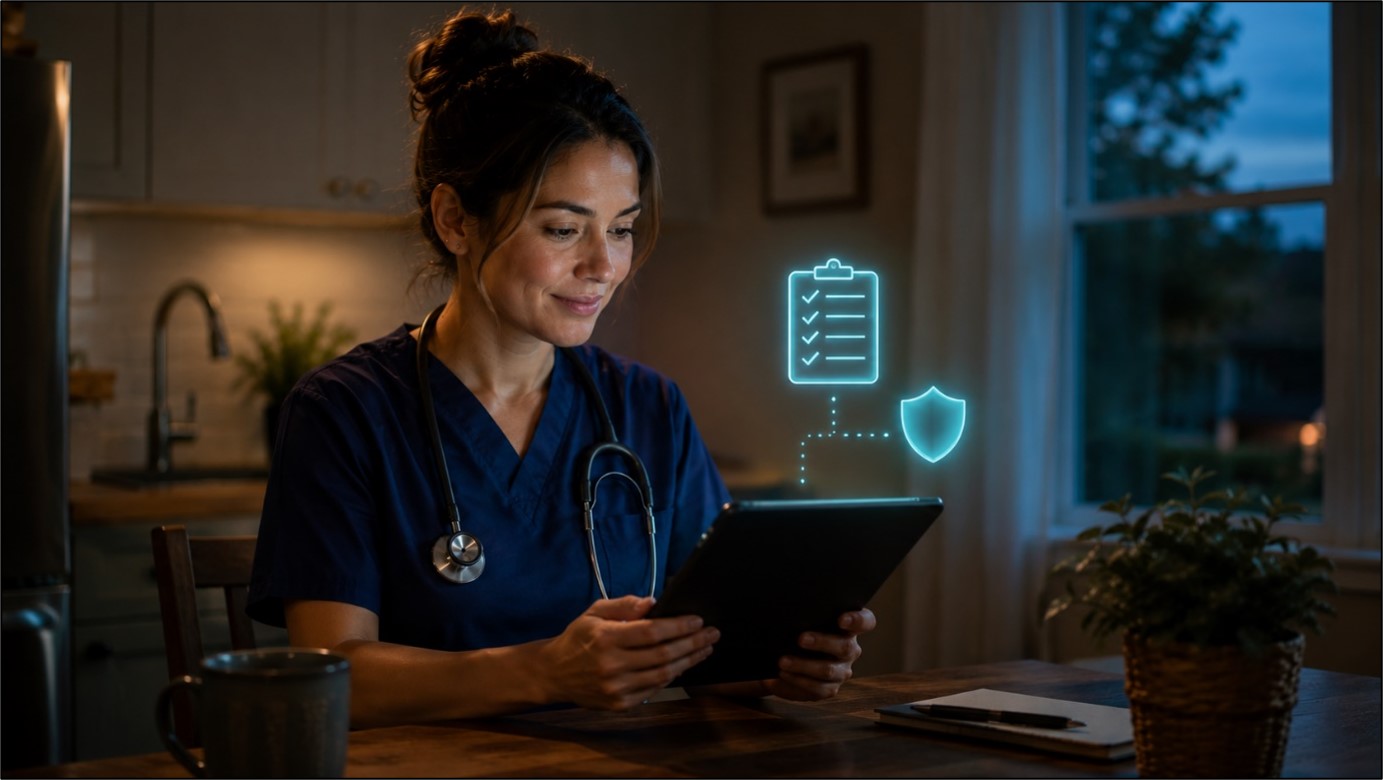
Before signing with any AI documentation vendor, ours included, get written answers to: BAA terms including subprocessors. Encryption standards in transit and at rest. Audio and transcript retention windows and deletion rights. Model training policy on your PHI. Independent security attestation, such as SOC 2 Type II, and when it was last renewed. Access controls and audit logging. Breach notification commitments. Consent workflow support. And data portability if you leave.
A serious vendor answers all nine without flinching. We built AutoMynd to be enterprise-grade from the ground up because home health agencies shouldn't have to choose between AI-native workflows and sleeping at night.
Bring this checklist to our demo. We'll go through every line at automynd.com.
.svg)


.png)