NEW: AutoMynd Unveils Patient-Centered AI EMR, Automating Episodes From Referral to Reimbursement Read more →
.svg)
.svg)

The AI scribe category was built for exam rooms. Suki, Abridge, DeepScribe, and the rest did real work proving that ambient documentation belongs in healthcare. But they were designed around a fifteen-minute office visit that ends in a SOAP note.
Home health is a different sport. The visit happens in a living room, runs forty-five minutes to an hour, and ends in an OASIS-E2 assessment or a HOPE tool, structured regulatory instruments that determine payment and publicly reported quality scores. A scribe that produces a beautiful narrative note and leaves the clinician to fill out the assessment by hand has solved the smaller half of the problem.
The market has noticed. Homecare Homebase announced an embedded scribe through a partnership in early 2026, and a wave of startups is building for this space. If you’re evaluating an AI scribe for your agency this year, here’s the frame I’d use.
A home health visit produces multiple documentation outputs at once: the visit note, the OASIS or HOPE items the encounter touched, medication reconciliation, care plan updates, and the evidence trail that supports all of it. The scribe’s real job is to capture the encounter once and structure it into all of those outputs, so the clinician reviews and confirms instead of re-entering.
That’s the design principle behind our Copilot. The conversation is captured ambiently, and the documentation arrives drafted: narrative, assessment items, and compliance checks, together, at the point of care. The clinician stays the decision-maker on every clinical judgment. The AI just makes sure the first draft already exists.

Exam-room scribes assume reliable connectivity and a quiet room. Home health gets neither. Dogs bark. Family members talk over each other. Rural counties drop signal. A scribe built for this setting handles noisy multi-speaker audio, works when the connection doesn’t, and syncs when it does. Ask every vendor how their tool behaves in a basement with one bar of signal, because that’s Tuesday for your nurses.
When I started AutoMynd, the value of conversation transcripts beyond charting was hard to articulate. CMS made the argument for me. With nationwide hospice site visits, expanded pre-claim review in six states, and the May 2026 enrollment moratorium signaling a sustained enforcement posture, a verbatim record that a visit occurred and covered what the note claims is one of the strongest assets an agency can hold. Documentation generated from the encounter itself is inherently more defensible than documentation reconstructed from memory at 9pm.
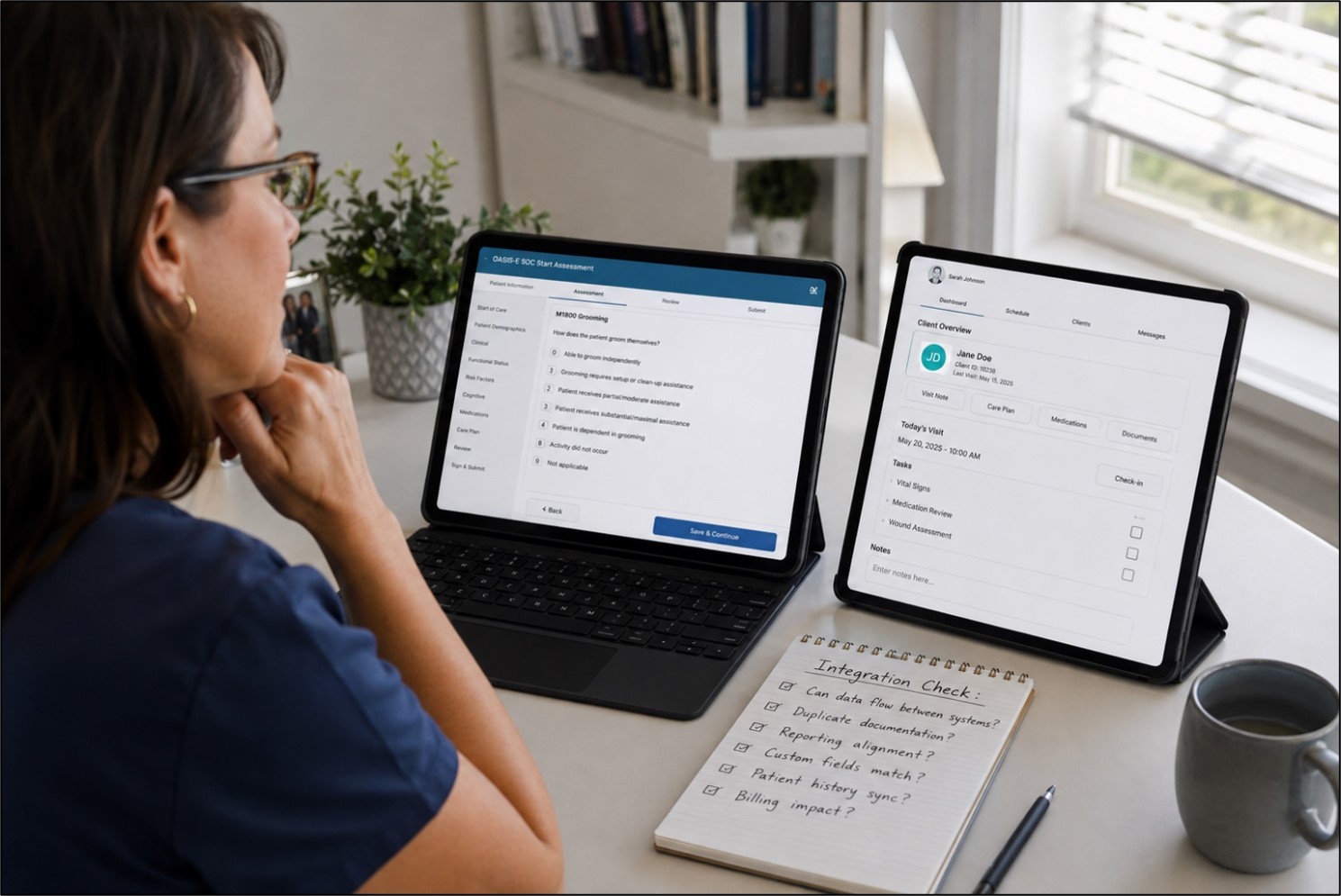
Does it structure OASIS-E2 and HOPE natively, or just write notes? Where does the output land, in your EMR workflow or in a separate app someone copies from? How does it handle consent and per-visit opt-out? What happens offline? And is it a standalone subscription bolted next to your EMR, or part of the system where QA, coding, and billing already live?
That last question matters more than it looks. A scribe that writes into someone else’s database is a guest. The gaps between guest and host are where errors and audit exposure live.
Efficiency was the original pitch for this category. Honestly, it’s table stakes now. The next generation gets judged on whether documentation quality, compliance posture, and clinician retention all move together. That’s the standard we’re building for at automynd.com.
.svg)


.png)