NEW: AutoMynd Unveils Patient-Centered AI EMR, Automating Episodes From Referral to Reimbursement Read more →
.svg)
.svg)
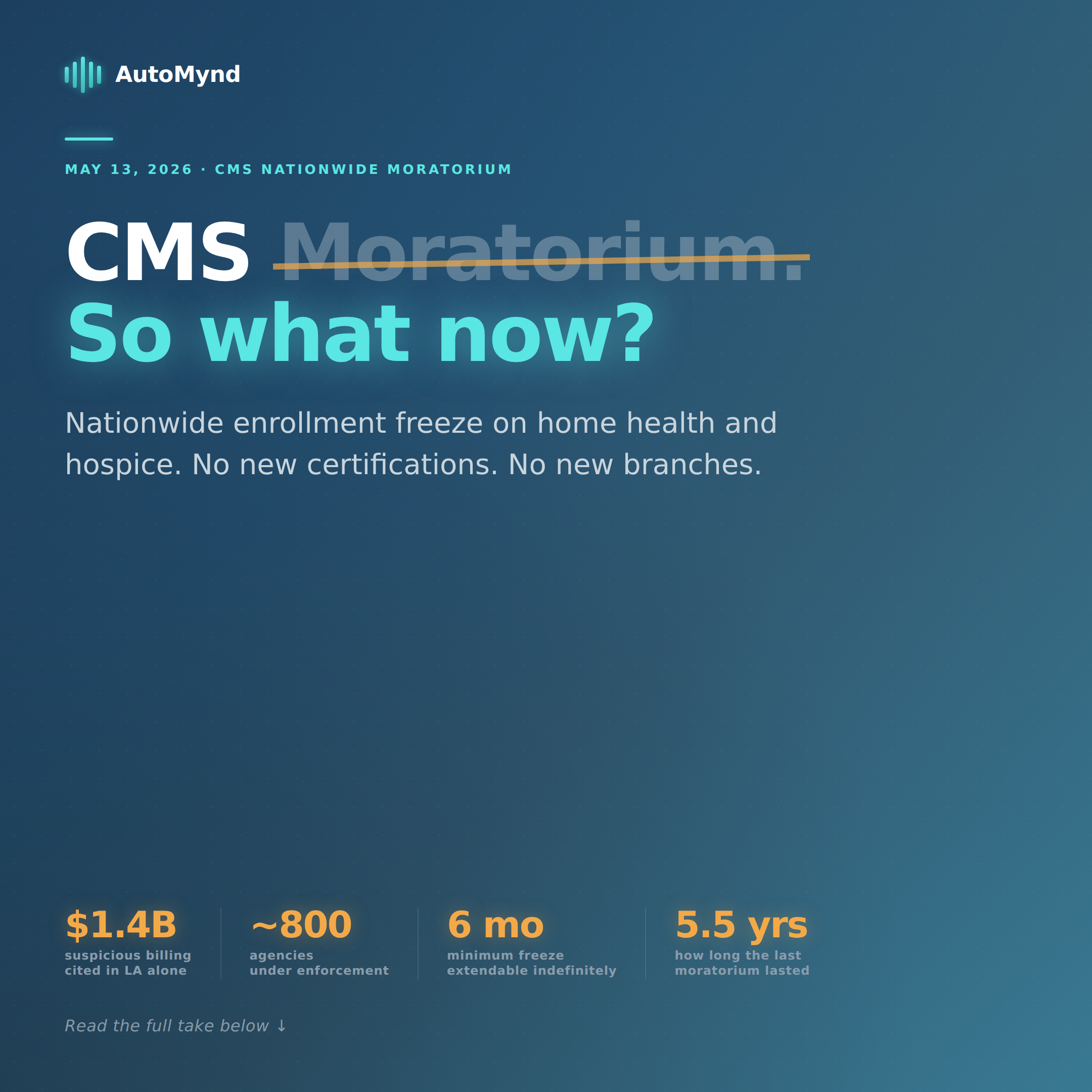
On May 13, 2026, the Centers for Medicare & Medicaid Services imposed a six-month nationwide moratorium on new Medicare enrollment for home health agencies and hospice providers. No new certifications. No new branches. No new practice locations. Effective immediately, with no phase-in and no comment period.
This is the most aggressive enrollment action CMS has taken in post-acute care in over a decade. The 2013 moratorium started in a handful of Florida counties and expanded to four states over five and a half years. This one is nationwide from day one.
If you already run an enrolled home health or hospice agency, here is the headline you need: you are not directly affected. The moratorium blocks new enrollments. It does not touch existing providers. You can keep admitting patients, keep delivering care, and keep billing Medicare exactly as you did on May 12.
Most of the panic circulating right now misses that. So before anything else, exhale. Then keep reading, because the enforcement package bundled alongside the freeze is what actually changes how you operate.
The moratorium blocks CMS from processing new initial Medicare enrollment applications for home health agencies and hospices anywhere in the United States, including all states, territories, and the District of Columbia. It runs initially through approximately November 13, 2026, and CMS can extend it in six-month increments. Given that the 2013 moratorium ran until 2019, agencies should plan for the possibility that this one outlasts its stated timeline.
Three things are frozen.
New agency enrollments. Any home health or hospice agency not already enrolled cannot get a Medicare billing number. Applications submitted to a Medicare Administrative Contractor before May 13 are grandfathered. Anything submitted on or after that date will be denied.
New branch and practice locations. If your growth plan involved opening a new location that requires a new enrollment, it is on hold.
Changes in majority ownership that trigger the 36-month rule. Any change in majority ownership within 36 months of initial enrollment forces the entity to enroll as a new provider, and the moratorium blocks that new enrollment. A large category of acquisition structures is effectively frozen. Equity transactions that qualify as a change of information rather than a change of majority ownership can still proceed, but the structuring is now delicate enough that no deal should move without healthcare counsel reviewing it against the 36-month rule first.
Existing providers undergoing none of the above continue without interruption.
CMS cited a significant potential for fraud, waste, or abuse in both sectors. The agency has already suspended roughly $70 million in payments to 773 hospices and 23 home health agencies in the Los Angeles area suspected of fraud. New hospice enrollment has surged in a concentrated set of states, with Arizona, California, Georgia, Nevada, Ohio, and Texas repeatedly named as fraud hotbeds. CMS has documented clusters of multiple agencies operating out of single addresses and a steady stream of criminal convictions tied to home health and hospice billing.
The moratorium is part of a broader enforcement initiative coordinated with the Vice President's Anti-Fraud Task Force, described by CMS as a whole-of-government effort to crush fraud and protect Medicare. Earlier in 2026, CMS imposed a similar nationwide freeze on DMEPOS supplier enrollment, which is still in effect. The pattern signals a sustained appetite for nationwide enrollment freezes rather than the targeted, county-level approach CMS used historically.
The moratorium is a blunt instrument. It applies equally to a fraudulent billing shell in a strip mall and a nonprofit planning to bring hospice into an underserved rural county. That asymmetry has drawn criticism across the industry.
The American Hospital Association flagged the effect on rural and underserved areas where hospitals already struggle to find appropriate discharge destinations, and urged CMS toward a more targeted, data-driven approach. The National Alliance for Care at Home raised concerns about existing agencies blocked from expanding into new service areas, and about the absence of clear milestones for lifting the freeze.
For any agency pursuing growth, the implications are immediate. De novo expansion through new Medicare-certified locations is off the table. M&A involving a change in majority ownership may be blocked or delayed under the 36-month rule. Branch openings in new territories cannot proceed. And applications filed after the moratorium lifts will face heightened screening for at least six months once the freeze ends. Consultants are already steering agencies toward acquisitions within existing licensed markets and toward careful structuring of any change-of-ownership transaction.
The moratorium is a gate check. It is designed to stop fraudulent agencies from getting certified and billing Medicare in the first place. But it raises a sharper question that every legitimate operator should sit with: why is it so hard to tell legitimate care delivery apart from fraudulent billing once an agency is already inside the system?
Most home health and hospice agencies run on infrastructure built for an earlier era of compliance, where clinical documentation, coding, quality assurance, billing, and patient engagement live in separate systems, owned by separate teams, on separate timelines. The care happens at the bedside. The documentation happens hours later. The QA review happens days later. The claim goes out a week after that. By the time anyone asks whether the care was delivered accurately and compliantly, answering means reconstructing a narrative from disconnected sources.
Fraudulent operators exploit those same gaps. They generate claims without delivering care, and fragmented systems are not designed to surface the difference in real time. The moratorium addresses the front door. The infrastructure gap between care delivery and compliance visibility is what let the fraud scale once it was inside.
That gap is also what turns a routine audit into a month of pain for an honest agency. When CMS asks you to prove a visit happened the way you billed it, the agencies with documentation traceable to the encounter answer in minutes. The agencies relying on memory-based charting and after-the-fact cleanup answer with additional documentation requests, denials, and appeals.
Skip the enrollment panic. You are enrolled. Focus on the four things that decide whether escalated enforcement is a non-event or a crisis for your agency.
Every piece of clinical documentation should connect directly to what happened in the visit. Ambient AI documentation that captures the encounter in real time and structures it for OASIS-E, HOPE, and other regulatory assessments creates a traceable chain from the bedside to the claim. Documentation generated from the encounter itself is inherently more defensible than documentation reconstructed from memory at 9pm. For agencies in the expanded pre- and post-claim review demonstration states, Florida, Illinois, North Carolina, Ohio, Oklahoma, and Texas, this is not optional. Pre-claim review means CMS reviews the documentation before you get paid cleanly. Thin charts mean delayed cash.
Traditional quality assurance is retrospective. QA staff review charts days after the visit, find discrepancies, and route corrections back to clinicians. That cycle introduces delay and leaves errors open long enough for claims to go out unresolved. Concurrent QA validates documentation against clinical evidence, coding guidelines, and regulatory requirements at the point of care. An agentic AI QA framework that cross-references the ambient transcript, the patient record, and CMS rules in real time catches the discrepancy before the chart ever reaches the QA queue, which is also where most PDGM coding revenue leaks out.
This is the piece most agencies overlook. When a patient confirms a visit, logs a medication, tracks a vital, or reports a symptom through a patient engagement app, that creates external validation no internal QA process can replicate and no fraudulent agency can manufacture. Patient-generated data is not only good for outcomes and HHCAHPS scores. It is evidence that the care relationship is real, active, and documented from both sides.
Agencies running six or seven disconnected tools, a legacy EMR plus a third-party coding vendor plus a standalone scrubber plus an ambient scribe add-on plus a scheduling system plus a patient app, are carrying integration risk as compliance exposure. Every handoff between systems is a place where information gets lost, delayed, or contradicted. An integrated home health and hospice platform where intake, documentation, QA, coding, and patient engagement operate in one environment shrinks that surface area and produces a single audit trail where every action and edit is traceable.
The moratorium will eventually end. The scrutiny it represents will not. CMS is building a more aggressive, data-driven enforcement apparatus: advanced analytics, real-time monitoring, a new public hospice scoring system, enhanced screening, and an expanding pre-claim review footprint. This is a structural shift in how the agency oversees post-acute care, not a temporary posture.
Agencies that treat this as a compliance fire drill will be reactive again when the next action lands. Agencies that use it to rebuild their infrastructure, so that compliance is a byproduct of connected, visible, patient-centered care delivery, are the ones that stop having to guess what comes next.
AutoMynd is an AI-native EMR and intelligent system of action for home health, hospice, and personal care providers. It connects the full care journey, from referral intake through clinical documentation, QA, coding review, patient engagement, and reimbursement, in one integrated environment. The capabilities most relevant to the posture described above:
Copilot. Ambient AI documentation that captures clinical encounters in real time, structures them for OASIS-E, HOPE, and other assessments, and runs compliance checks at the point of care.
QAgent. An agentic QA framework that cross-references ambient transcripts, patient records, and CMS guidelines to flag discrepancies with evidence-linked citations before claims are submitted.
Patient360. A longitudinal patient record and engagement app that creates continuous visibility into the care journey between visits, including medication adherence, vital tracking, and visit confirmation.
IntakeIQ. AI-powered referral intake that automates patient profile creation and flags eligibility and authorization issues at the point of entry.
MyndSight. Value-based care analytics with HHCAHPS monitoring, quality metrics, and financial performance visibility.
AutoMynd is built around a human-in-the-loop model. The AI flags, recommends, and surfaces evidence. The clinician and the agency remain the decision-makers.
To see how AutoMynd supports your agency's compliance and operational readiness ahead of escalating CMS enforcement, book a demo at automynd.com.
.svg)



.png)