NEW: AutoMynd Unveils Patient-Centered AI EMR, Automating Episodes From Referral to Reimbursement Read more →
.svg)
.svg)
.png)
Home health billing used to be simple on paper.
Document the visit to the EMR, code it, submit the claim through the clearinghouse, work the denials.
That stack is now under strain.
Denial rates remain stubbornly high across healthcare, with each denial delaying cash or erasing it altogether. Payers are increasing scrutiny on documentation, PDGM groupings, and face to face and OASIS alignment. AI and automation are rapidly reshaping medical billing and coding, but in many agencies the billing stack still looks like 2015.
The result is familiar: rework, coder burnout, QA bottlenecks, and cash locked up in preventable denials.
The fix is not “more billers” or “a better EMR.”
It is a new layer in the stack.
High performing agencies are inserting an AI chart review layer between the EMR and the clearinghouse. That layer acts as a system of action for home health billing, AI medical coding, and denial prevention.
The legacy home health billing stack looks roughly like this:
1. Intake and scheduling
2. Documentation in the home health EMR
3. Manual QA and home health coding
4. Billing export
5. Clearinghouse and payer
6. Denial management, mostly manual
On good days this works. On real days it fails for predictable reasons:
· Documentation does not match billing reality
OASIS E assessments, visit notes, and diagnosis lists are inconsistent or incomplete, especially for complex PDGM cases. That leads to incorrect groupings, missed comorbidities, and unnecessary LUPA risk.
· QA and coding catch issues too late
By the time a QA nurse or coder sees the chart, the visit is done, the episode is in motion, and clinicians have moved on to new patients. Fixes require back and forth messages or addenda that rarely happen on scale.
· Denials are treated as a billing problem, not a system problem
Teams work denial queues by hand, often without structured root cause analysis. In many providers, AI in medical billing is applied only to claim status and denial categorization, not to the upstream chart that created the problem.
· The EMR is a system of record, not a system of action
EMRs excel at storing data and enforcing required fields. They are not built to continuously re‑interpret documentation, simulate how a payer will see the chart, or orchestrate work across QA, coding, and billing.
You can bolt more tools onto this stack, but if every safeguard lives at the very end, the economics of home health billing will not improve.
Executives already think in terms of systems of record.
In home health that usually means:
· The EMR as the clinical and operational source of truth
· The clearinghouse and payer portals as the financial record of claims, payments, and denials
The system of action is different. It does not simply store data. It:
· Reads data across systems in near real time
· Uses AI to detect risk, missing information, and optimization opportunities
· Pushes structured tasks and recommendations back into the workflow
· Learns over time from outcomes, such as paid claims and denials
In billing and revenue cycle management, AI medical coding and AI medical billing only move the needle when they are embedded as systems of action, not standalone dashboards.
For home health and hospice, the natural place to put that system of action is between the EMR and the clearinghouse, where it can see the full chart and influence what becomes a billable, defensible claim.
At a high level, an AI chart review layer for home health billing and coding sits on top of the EMR and acts as a specialized reviewer for PDGM and Medicare compliance.
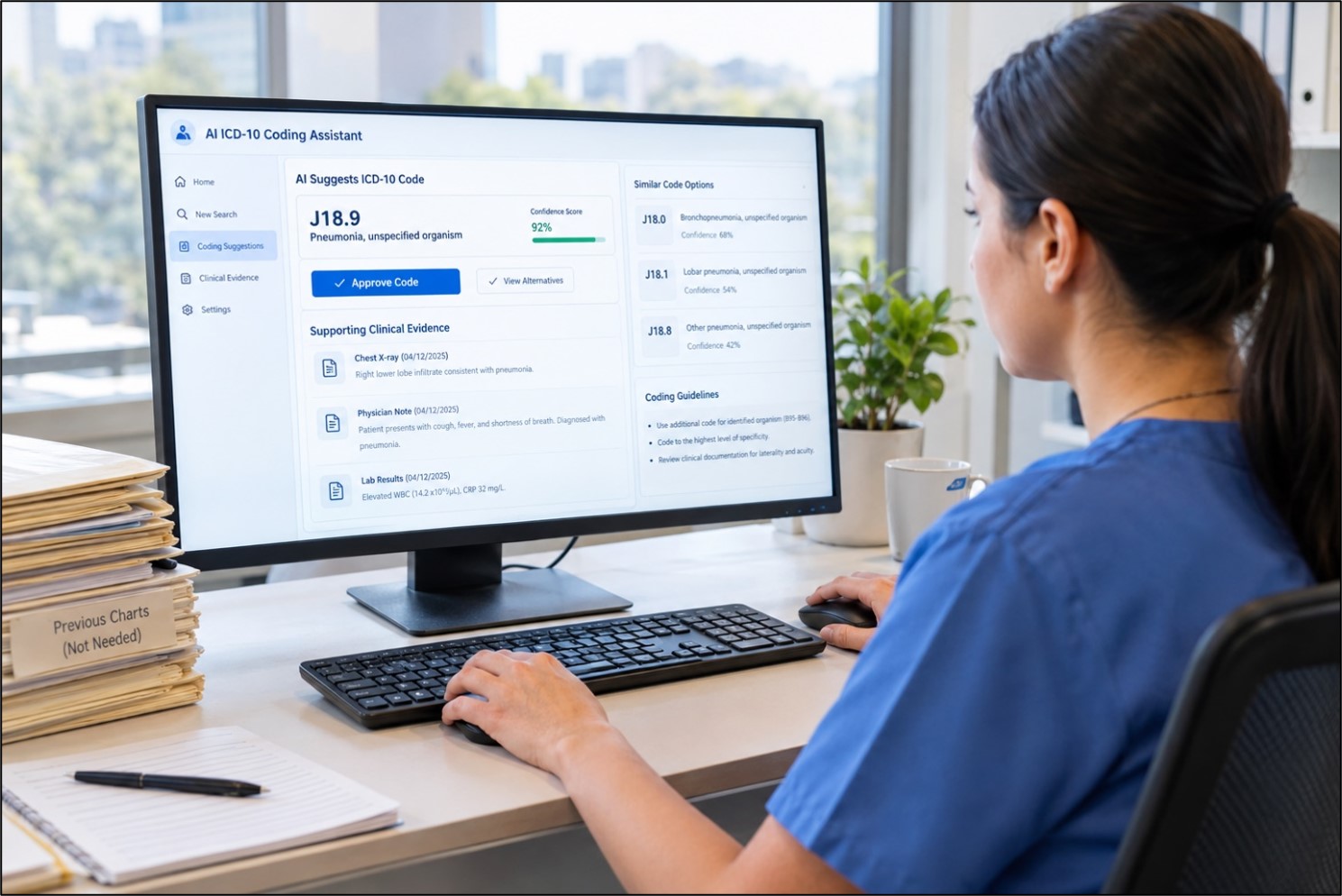
Instead of only suggesting ICD codes, the AI engine reads:
· OASIS E responses
· Skilled nursing and therapy visit notes
· Medication lists and problem lists
· Orders, face to face documentation, and plan of care
It then crosses checks how those elements will map into PDGM groupings, comorbidity adjustments, and Home Health Value Based Purchasing risk. This is where AI in medical coding becomes more than a faster way to search code books.
Using rules plus machine learning, the layer flags issues such as:
· Inconsistent primary diagnosis between OASIS and coding
· Missing documentation for skilled need or homebound status
· Patterns that historically led to claim denials or medical review
Instead of waiting for a human QA nurse to parse all of this, the AI chart review system prioritizes which charts need attention and why. That directly supports clean claim rate, denial management, and audit readiness.
For charts that pass basic QA, the system can:
· Propose a complete diagnosis list that reflects documentation
· Highlight secondary diagnoses that impact PDGM reimbursement
· Validate that OASIS items and codes support the level of care
Coders remain in control. AI medical coding works here as an intelligent assistant that removes repetitive search and cross checking, rather than a fully autonomous black box.
A system of action does not just generate a report. It creates targeted work:
· For clinicians: specific documentation gaps to address in the next visit
· For QA: a prioritized queue of high-risk charts with context
· For billing: a view of which claims are truly ready for submission
This is where the AI layer earns its place in the home health billing stack. It changes how work moves, not only how fast it moves.
Finally, every paid claim, partial payment, or denial becomes training data.
The chart review engine learns which combinations of documentation, coding, and payer behavior lead to clean reimbursement, and which patterns are likely to trigger ADRs or medical review. Over time, the system becomes a specialized denial prevention engine for home health and hospice billing, not just generic revenue cycle AI.
When you insert AI chart review as a system of action, the stack changes shape:
1. Intake and authorization
Eligibility, benefits, and initial orders are captured in the EMR. Some agencies already apply AI to intake, but most billing problems still originate after the start of care.
2. Documentation in the EMR
Clinicians chart visits, complete OASIS E, and update plans of care. Ambient AI documentation tools can already shorten this step and improve completeness.
3. AI chart review andpre QA intelligence layer
The new layer reads the entire chart, runs automated QA, performs AI medical coding support, and outputs structured recommendations and risk flags.
4. Focused QA and coding review
Human QA nurses and coders review AI flagged issues instead of scanning every chart from scratch. They approve, modify, or override suggestions, retaining clinical and compliance judgment.
5. Billing and claimgeneration
Only charts that meet defined quality and compliance thresholds move into billing. At this stage, AI in medical billing can still help with claim status follow up and denial prediction, but the heavy lifting is already done.
6. Clearinghouse andpayer
Claims are cleaner on first submission, which reduces rework and DSO and shrinks denial queues.
7. Feedback loop to theAI layer and operations
Denial reasons, payment patterns, and audit outcomes feed back into the AI engine and into operational coaching for clinicians and coders.
This architecture turns home health billing software and EMRs from static repositories into active participants in revenue cycle management.
Executives care about impact on cash, cost, and risk.
When AI chart review and AI coding support sit between the EMR and clearinghouse, agencies can expect structural changes:
· Higher clean claim rate and lower denial rate
Industry evidence shows AI driven medical billing and coding can significantly reduce errors and denials by catching issues before submission, not after.
· More capacity from the same QA and coding team
If AI handles the first pass review across OASIS E, visit notes, and PDGM groupings, coders and QA nurses can focus on complex charts and clinical edge cases instead of routine validation.
· Shorter DSO and more predictable cash flow
Cleaner first pass claims move through payer systems faster, which compounds across hundreds or thousands of home health episodes.
· Stronger compliance posture
A chart that has been reviewed by AI plus human QA with a full audit trail is better prepared for ADRs and RAC audits. AI medical coding can also help agencies adapt quickly to ICD updates and payer policy shifts.
Given the projected growth of AI in medical coding as a market and its increasing adoption by providers and payers, agencies that do not modernize their billing stack risk competing with organizations that have structurally lower denial rates and administrative costs.
.svg)


.png)